Friday, 19 May 2017

Iranians head to the polls for presidential vote

Iranians were headed to the polls on Friday for the first presidential election since the landmark 2015 nuclear agreement, in a vote that could have serious implications for the future of the country and its relationship with the West.
President Hassan Rouhani, a moderate, was seeking a second term as he Face off  against Ebrahim Raisi, the frontrunner among the conservative set.
The position of president is the second most powerful in Iran after the Supreme Leader, who is commander-in-chief and controls the Guardian Council. The May 19 vote will be the first stage, with a possible runoff vote if none of the candidates wins a simple majority of 50 percent +1 of the votes.
All voting is to be concluded before the start of the holy month of Ramadan.

US slaps sanctions on Venezuela Supreme Court judges

Venezuela's Supreme Court, led by Moreno, assumed the powers of congress in March 
The United state has imposed sanctions on Venezuela's chief judge and seven other members of the country's Supreme Court as punishment for seizing powers from the opposition-led congress earlier this year.
Those sanctioned will have their assets frozen within US jurisdiction, and US citizens will be barred from doing business with them, the US treasury department said on Thursday.
The new sanctions package was aimed at stepping up pressure on supporters of President Nicolas Maduro amid growing international concern over a Crackdown on mass street protests.
"The Venezuelan people are suffering from a collapsing economy brought about by their government's mismanagement and corruption," Steven Mnuchin, the US treasury secretary, said in a statement.
"Members of the country's Supreme Court of Justice have exacerbated the situation by consistently interfering with the legislative branch's authority," he said.

Trump Saudi visit forecast to burnish his image with Muslims

© Nicholas Kamm, AFP | US President Donald Trump and Saudi Deputy Crown Prince Mohammed bin Salman speak to the media in the Oval Office at the White House in Washington, DC, on March 14, 2017.
Latest update : 2017-05-19

President Donald Trump may be embroiled in accusations of wrongdoing in the United States, but none of that is likely to colour his visit to Saudi Arabia on Friday, where he is expected to be greeted with warmth and praise.

The trip, Trump’s first international tour, includes stops in Saudi ArabiaIsrael, the Palestinian Territories, Italy and Belgium. The President’s weekend in the desert kingdom will centre around three main events: a Saudi-US summit, a Gulf Cooperation Council (GCC)-US summit and an Arab Islamic American Summit, which is to be attended by leaders of the world’s Islamic nations.
While in the kingdom, Trump is scheduled to give a speech on radical Islam and, in keeping with his own predilections, participate in a Twitter forum with young people.
Several of his hosts, the Saudis among them, are invested in making the trip a triumph. They see Trump as an ally because of his vociferous opposition to the Iranian government, which the Saudis see as a destabilising force in the region. Relations between the kingdom and the US had frayed toward the end of President Barack Obama’s tenure.
While President Obama had strayed from longstanding US alliances in the Middle East, Trump has “signaled a return to a traditional view, which is that there are good powers and bad powers in the region,” said Bernard Haykel, professor of Near Eastern Studies at Princeton University.
In that view, Saudi Arabia and Israel are in the good column. Iran is in the bad.
A foregone conclusion
The success of Trump’s trip has not been left to chance. Saudi Arabia and the Gulf States have already negotiated, or are in the final stages of negotiating, accords with the United States that are expected to be announced during Trump’s visit. Among them is a series of arms deals with the kingdom worth more than $100 billion. That number could rise as high as $300 billion over the next decade, a senior White House official told Reuters on condition of anonymity.
The arms deal highlights a welcome reversal of policy for the Saudis. Last year the Obama administration halted some weapon sales to the Kingdom because of its deadly military operation in Yemen. The Trump administration scrapped that decision in March.
Trump and Saudi officials are also expected to announce a package of Saudi investment in US infrastructure. And Trump is expected to lay out his vision for a Gulf State-backed NATO-style defense force for the Middle East.
“The Saudis are basically trying to present Trump with win-win situations,” Haykel said.
Trump will hold bilateral meetings with leaders of the six Gulf Cooperation Council (GCC) states, some of whom he has already encountered. On Monday he hosted Abu Dhabi Crown Prince Sheikh Mohammed bin Zayed at the White House. The two governments recently concluded a defense cooperation agreement, and the State Department last week approved a $2 billion sale of arms to the UAE.
Tackling radical Islam
The President’s speech on radical Islam will coincide with the opening of a centre in Riyadh dedicated to promoting moderate Islam. The address will be “inspiring but direct” and will highlight the need to confront radical ideology, National Security Advisor H.R. McMaster said.
The speech is intended, in part, to signal that the President has moved away from the inflammatory language he used about Muslims during his campaign and his repeated assertions that Saudi Arabia was behind the attacks on 9/11.
“The gesture in choosing Saudi Arabia as his first country [to visit as president] is a refreshing pivot from the campaign rhetoric,” said Fatima Baeshen, a director at the Arabia Foundation in Washington, D.C. “It’s symbolic to the global Muslim community, given that Saudi Arabia is home to two holy sites in Islam.”
A two-way street
The trip has benefits for the Saudis as well. The weekend will include a Saudi-US CEO forum on Saturday, and several investment deals are expected to be inked as part of the Vision 2030 social and economic reform initiative the Kingdom unveiled last year. Saudi Arabia will also issue new licenses allowing US companies to operate there.
The trip won’t all be talk of business and terror. Over the weekend, American country singer Toby Keith will give a concert in Riyadh. The event is free—but open to men only.
Trump narrowly avoided a sticky moment at the summit of Arab leaders. Early in the week, Sudan’s foreign minister told reporters in Geneva that his nation’s president, Omar al-Bashir, would attend the forum of Arab leaders. The International Criminal Court has issued a warrant for war crimes against Bashir, and the idea that an American president would attend an event with an accused war criminal outraged former US officials and human rights activists.
But Trump dodged that bullet.

Japan cabinet approves Emperor Akihito abdication bill

If Akihito is allowed to abdicate, it would be the first time a Japanese emperor has stepped down since 1817 
Japanese government has approved a one-off bill that allows ageing Emperor Akihito to step down from the Chrysanthemum Throne in what would be the first such abdication in two centuries.
Prime Minister Shinzo Abe's cabinet signed off on the legislation on Friday, Chief Cabinet Secretary Yoshihide Suga told reporters.
The bill will now be sent to parliament, where it is expected to pass. 
Reports of the 83-year-old Akihito's desire to retire surprised Japan when they emerged July 2016.
"When the emperor first hinted that we might think about his abdication, most people were shocked because we were not prepared to hear that, but now many Japanese people support his idea," Yoshiki Mine, president of Institute for Peaceful Diplomacy in Tokyo, told Al Jazeera. 
Akihito, who has had heart surgery and prostate cancer treatment, said in rare public remarks last year he feared age might make it hard for him to fulfil his duties.
But current Japanese law has no provision for abdication, thus requiring politicians to craft legislation to make it possible.
The bill is one-off legislation that would allow only Akihito to step down, with no provisions for future emperors, but Mine said he believed it could serve as a sort of precendent 
It also makes no reference to the controversial issue of changing the system to allow women to inherit the throne, or to stay in the imperial family upon marriage, Japanese media said, although political parties are discussing a separate resolution on the topic.
"The bill is a certain kind of compromise between the more orthodox and conservative thinkings and the awareness of the new situation," Mine said.

Tuesday, 16 May 2017

Why are journalists being killed in Mexico that much?

 Mexico is not a war zone but yet it is one of the most dangerous places in the world for reporters.  Recently  journalist Javier Valdez is the latest of several members of the media who have been killed this year alone.  The Committee to Protect Journalists (CPJ) says widespread impunity "allows criminal gangs, corrupt officials, and cartels to silence their critics".  The Mexican government repeatedly promised to protect journalists, and freedom of speech but the shootings and beatings continue. So, what should be done to stop the targeting of journalists?  Presenter: Sami Zeidan  Guests:  David Shirk - Associate Professor of Political Science and International Relations at the University of San Diego  Miguel Basanez - Former Mexican Ambassador to the US  Steven Dudley - The Co-director of InSight, an initiative aimed at monitoring organised crime in the Americas

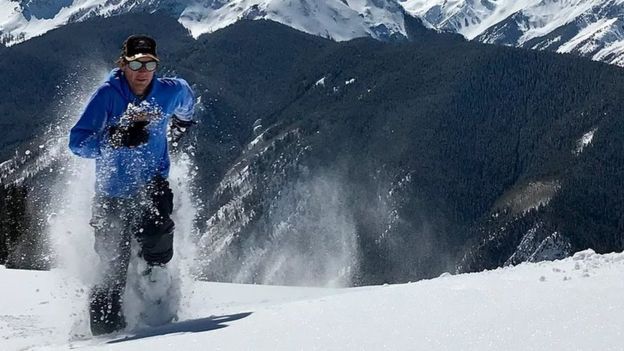
man who tried to climb Everest has been arrested in Kathmandu

Ryan Sean Davy training ahead of his Everest adventure   
man who tried to climb Everest has been arrested in Kathmandu
Nepalese friend of Ryan Sean Davy said the climber was being questioned by tourism officials and is due to appear in court on Wednesday where he is expected to receive a heavy fine.
"He is in good heart although worried about his finances and the scale of the punishment he will receive because has no cash, which is why he mostly travelled on foot."
Mr Davy, US-based South African, 43, he said he climbed alone to a height of 7,300m (24,000ft) before he was found hiding in a cave by  the officials who also confiscated his passport because he did not have a permit to climb Everest.

He has apologised but also he complained of being treated harshly by the officials. It is extremely rare for someone to attempt climbing Everest by themselves.
he said "I have no idea of the outcome regarding my Everest no-permit climb," Mr Davy posted on Facebook on Tuesday

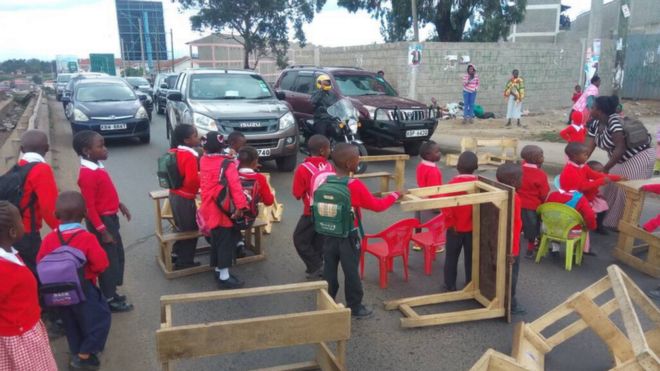
Kenyan pupils protest after Nairobi school demolished

Pupils of Kenyatta Golf Course Academy, Nairobi block Mbagathi Road with their desks after their school was demolished.Image copyright
Image captionThe demonstration ended peacefully
Primary schoolchildren have used their desks to block a major road in Kenya's capital Nairobi after their school was demolished.
The Kenyatta Golf Course Academy was knocked down at the weekend following a land dispute.
They were joined by their parents and teachers as they chanted: "We want our school, we need to study in school."
Several Kenyan schools have been demolished in recent years because of arguments over title deeds.
In some cases, corrupt officials have issued multiple deeds for the same property.
One parent protesting during the rush-hour said: "We are demonstrating because we did not have any notice to vacate."
Teachers are reported to be concerned that the demolition means they have lost their jobs.
The demonstration ended peacefully.
Two years ago police fired teargas to disperse protesting schoolchildren in Nairobi after their playground was sold to a developer.