Showing posts with label latest News. Show all posts

Saturday, 5 August 2017

UN Security Council to vote Saturday on N. Korea sanctions

UNITED NATIONS: The UN Security Council will vote Saturday on a US-drafted resolution toughening sanctions on North Korea, diplomats said Friday. 

The vote is scheduled for 3 pm (1900 GMT) on the new measures that could deprive North Korea of $1 billion in annual revenue from exports of coal, iron, lead and seafood. 

As Kenya elections draw near, country reveals an electorate divided by tribe

Residents of Mathare, a slum in Nairobi, prepare for Tuesday's presidential election. 
A concrete bridge and a narrow, garbage-filled river divide the slum of Mathare into two parts, a space between ethnic groups and voting blocs that are competing fiercely — and many say dangerously — over Kenya’s presidential elections scheduled for Tuesday.
Here in one of the most economically successful and stable countries in East Africa, Mathare is only a few miles away from Nairobi’s rising skyline. Tech firms have popped up on the city’s periphery. Every week, thousands of tourists pile into sleek safari trucks. This spring, the top U.N. humanitarian official here, Siddharth Chatterjee, called Kenya, “a beacon of hope in a region mired in fragility.”
But with the election approaching, Mathare feels far from stable. On one side of the rutted bridge is a community of ethnic Kikuyus, the tribe of incumbent Uhuru Kenyatta, 55. On the other side are the Luos, the tribe of opposition candidate Raila Odinga, 72.

Most days, those tribes peacefully coexist, as the slum is consumed by honking minibuses and a frenzy of commercial activity, with traffic moving across the bridge in both directions. But as the election approaches, it is a line not to be crossed.

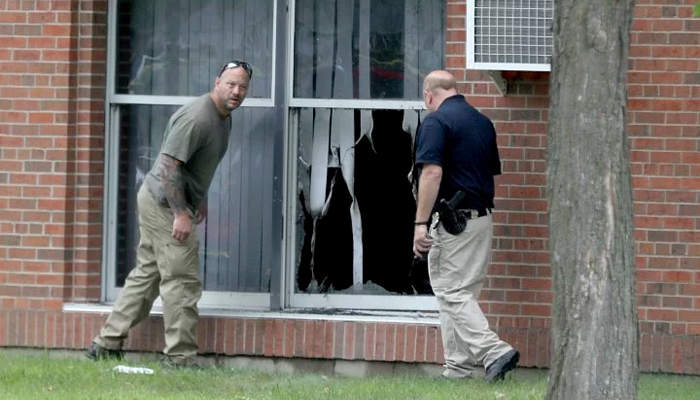
FBI takes over probe of bombing of Minnesota mosque


Law enforcement officials investigate an explosion at the Dar Al-Farooq Islamic Center in Bloomington, Minnesota, August 5, 2017. Time via Star Tribune/David Joles/AP

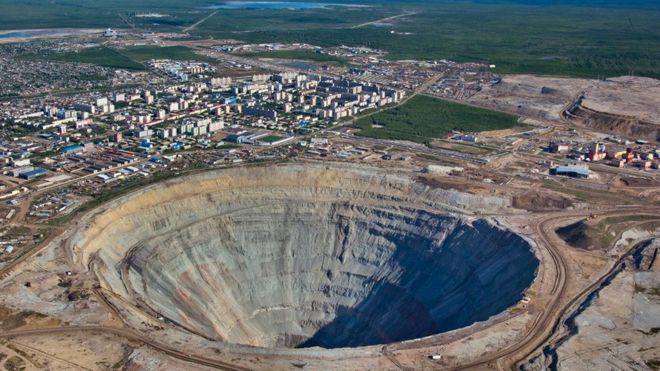
Eight missing in flooded diamond mine

The open-pit Mir mine in Mir
Eight miners are missing after a flood at Russia's largest diamond mine.
Water leaked into an underground shaft on Friday morning when more than 100 workers were inside.
Most have been rescued from Mir mine in eastern Siberia, according to diamond company Alrosa, which runs it.
However, the company said reports that those still missing had been located were not true and the search continues. Divers have reportedly arrived at the scene.
The town of Mirny in Yakutia has declared a state of emergency.
One man was rescued on Saturday morning.
He is in intensive care at a nearby hospital with a bruised lung, but his life is not in danger, Alrosa said.
Chief Executive Sergey Ivanov said every effort was being made to find the other workers.
The company said 142 people had been brought safely back to the surface so far.

Where speaking several languages is a given

women in beach clothes walking past a sign that reads "We sell English newspapers mags and books"
Are you the kind of person who points at menus to be understood while you're abroad? If so, you're not alone and you'd fit in well in the UK suggested more than half of UK people do the same, and nearly as many are embarrassed by their lack of language skills.
Some 15% of people even admitted they had spoken English in a foreign accent in a vain attempt to be understood à la footballer Joey Barton a few years back.
But the Brits are in the minority in this regard. It's estimated that 60-75% of people around the world are at least bilingual, and in some places it's the norm to speak three or four languages without blinking an eye.

Trump administration approves sale of attack planes to Nigeria

The Trump administration approves attack planes to be used by the Nigerian military to counter the Boko Haram insurgency and illicit trafficking..View page

Friday, 4 August 2017

Trump's 17-day holiday causes a stir

US President Donald Trump waves as he boards Air Force One at Joint Base Andrews near Washington, DC before travelling to Bedminister, New Jersey, for the weekend.

Trump's 17-day holiday causes a stir

View post

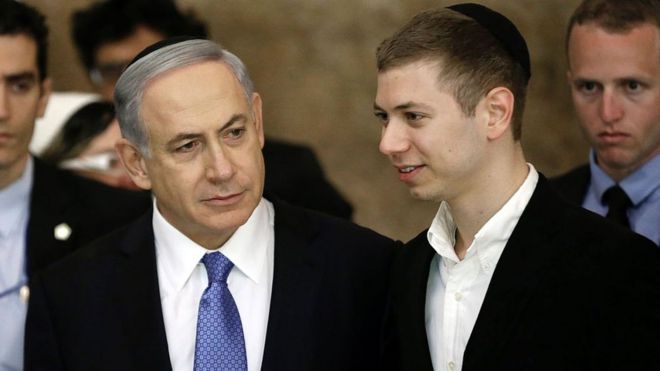
Israeli PM Netanyahu's son in social media row over dog poo

Benjamin and Yair Netanyahu (file photo)
A son of the Israeli prime minister is facing a public backlash amid an escalating row over his reported failure to pick up his dog's droppings.
Yair Netanyahu, 25, responded with an obscene gesture, a neighbour said on Facebook, after she told him to clear up the waste left in a Jerusalem park.
Mr Netanyahu hit back at critics, leading the son of a former Israeli PM to accuse him of racism and homophobia.
The Netanyahus say Israeli media often unfairly focuses on their family.
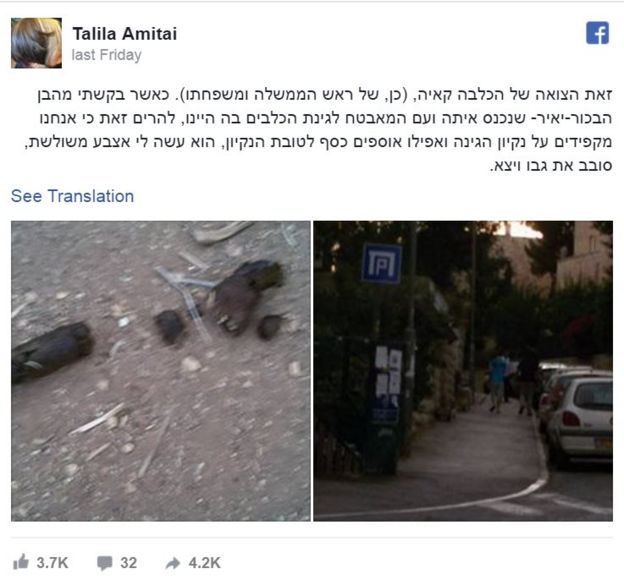
The spat began when Talila Amitai posted her account of the exchange with Yair Netanyahu, whom she said raised his middle finger when she asked him to pick up his dog Kaya's poo.
Talila Amitai Facebook post

People think Neymar's Paris St-Germain move was motivated by money

Brazil forward Neymar quoted it is "sad" that people think his world record move from Barcelona to Paris St-Germain was motivated by money.
The 25-year-old joined the French club for a fee of 222m euros (£200m) and he will earn 45m euros (£40.7m) a year.
Neymar, who could play in PSG's first league match of the season on Saturday, said his price was "not a burden".
PSG chairman Nasser Al Khelaifi added that Neymar could have earned more money at another club.

Secret Service quits Trump Tower

Police outside Trump Tower on 7 November 2016
The Secret Service has moved out of Trump Tower in New York City to a street-level trailer in a dispute with the Trump Organization over a lease.
The federal agency which protects US presidents has been renting office space in the Midtown Manhattan skyscraper since 2015.
But its representatives are baulking at the cost and other unspecified rental terms, reports the Washington Post.
The Trump Organization said the agency should look elsewhere.
Since Mr Trump became a front-runner in the presidential race two years ago, the Secret Service has stationed its command post in a unit one floor below his triplex residence.

Tuesday, 16 May 2017

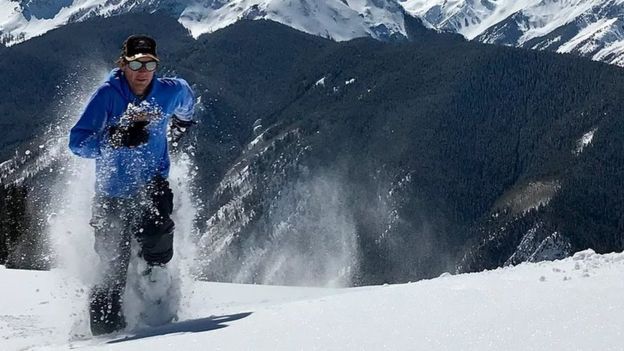
man who tried to climb Everest has been arrested in Kathmandu

Ryan Sean Davy training ahead of his Everest adventure   
man who tried to climb Everest has been arrested in Kathmandu
Nepalese friend of Ryan Sean Davy said the climber was being questioned by tourism officials and is due to appear in court on Wednesday where he is expected to receive a heavy fine.
"He is in good heart although worried about his finances and the scale of the punishment he will receive because has no cash, which is why he mostly travelled on foot."
Mr Davy, US-based South African, 43, he said he climbed alone to a height of 7,300m (24,000ft) before he was found hiding in a cave by  the officials who also confiscated his passport because he did not have a permit to climb Everest.

He has apologised but also he complained of being treated harshly by the officials. It is extremely rare for someone to attempt climbing Everest by themselves.
he said "I have no idea of the outcome regarding my Everest no-permit climb," Mr Davy posted on Facebook on Tuesday

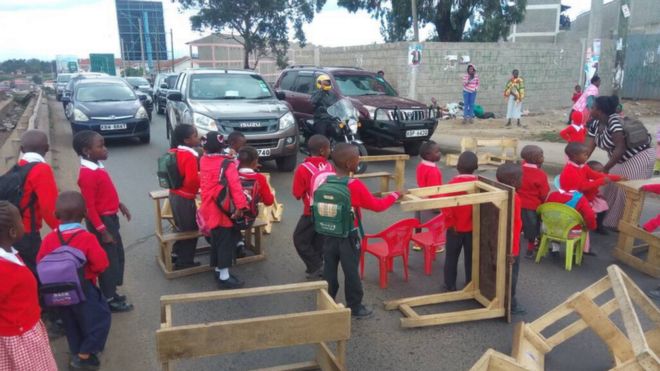
Kenyan pupils protest after Nairobi school demolished

Pupils of Kenyatta Golf Course Academy, Nairobi block Mbagathi Road with their desks after their school was demolished.Image copyright
Image captionThe demonstration ended peacefully
Primary schoolchildren have used their desks to block a major road in Kenya's capital Nairobi after their school was demolished.
The Kenyatta Golf Course Academy was knocked down at the weekend following a land dispute.
They were joined by their parents and teachers as they chanted: "We want our school, we need to study in school."
Several Kenyan schools have been demolished in recent years because of arguments over title deeds.
In some cases, corrupt officials have issued multiple deeds for the same property.
One parent protesting during the rush-hour said: "We are demonstrating because we did not have any notice to vacate."
Teachers are reported to be concerned that the demolition means they have lost their jobs.
The demonstration ended peacefully.
Two years ago police fired teargas to disperse protesting schoolchildren in Nairobi after their playground was sold to a developer.

US accuses Syrian regime of using 'crematorium' to cover up mass killings


The United States on Monday accused Syria of building a prison crematorium to destroy the remains of thousands of murdered detainees, putting pressure on Russia to rein in its ally.

Warning Moscow it should not turn a blind eye to Bashar al-Assad's crimes, the State Department released satellite images that it said backed up reports of mass killings at a Syrian jail.
"The United States is on record, has stated many times, that we are appalled by the atrocities that have been carried out by the Syrian regime," said Stuart Jones, the top US diplomat for the Middle East.
"And these atrocities have been carried out seemingly with the unconditional support from Russia and Iran."
And he added a message to President Vladimir Putin's government: "Russia must now, with great urgency, exercise its influence over the Syrian regime to guarantee that horrific violations stop now."
Jones' warning came as UN-mediated peace talks between Damascus and the Syrian opposition were about to resume in Geneva, and appeared aimed at maintaining pressure on Assad's backers.
The head of the opposition delegation to the talks welcomed the US statement, but complained it had come too late.
"This is but a drop in the ocean. What happens in the regime's prisons is much uglier than this," Nasr al-Hariri said.
"The time has come for the world -- chiefly the US -- to act to halt these human rights violations."
'Cover up'
One newly released image, a commercial satellite photograph dating back to January 2015, shows snow melting on the roof of a building attached to the Saydnaya military complex north of Damascus.
This, along with an earlier picture allegedly showing heavy-duty ventilation systems on the structure, appears to support earlier claims by rights groups that Saydnaya is an execution center.
"Beginning in 2013, the Syrian regime modified a building within the Saydnaya complex to support what we believe is a crematorium" built in "an effort to cover up the extent of the mass murders taking place in Saydnaya," said Jones.
Jones, an acting assistant secretary of state, said Washington's information came from credible humanitarian agencies and from the US "intelligence community" -- implying that classified evidence beyond the commercial pictures exists.
At Saydnaya, Syria holds up to 70 prisoners in cells that are meant for five, Jones alleged.
"And according to multiple sources, the regime is responsible for killing as many as 50 detainees per day at Saydnaya."
He did not give an official estimate for the total number killed, but cited an Amnesty International report that between 5,000 and 11,000 had died in the prison between 2011 and 2015.
Assad's regime, he alleged, has detained between 65,000 and 117,000 people over the same period -- the first five years of a civil war that has left hundreds of thousands dead.
It was not immediately clear why the United States waited more than two years to present its evidence.
Jones said: "I would say that this information has been developing."
He also said Secretary of State Rex Tillerson had raised concerns about Assad's brutality with Russia's Foreign Minister Sergei Lavrov during his visit to Washington last week.
Sarin attack
Moscow, along with Iran, is Syria's main foreign backer and Washington believes Russian pressure is the only thing that will compel Assad to negotiate a peace deal.
President Donald Trump came to office vowing to focus US efforts in Syria on defeating the Islamic State group, a jihadist force that exploited the civil war to seize the east of the country.
He also said he hoped to work with Putin towards this goal.
But relations with Moscow, already dire under Trump's predecessor Barack Obama, have not improved and Assad has continued to bombard civilian areas in his battle with opposition rebels.
Last month, when Assad was again accused of using the banned nerve agent sarin in a strike on his own people, Trump ordered a retaliatory US cruise missile strike on a Syrian air base.
When asked whether the Saydnaya deaths could trigger action, White House spokesman Sean Spicer said Trump would never "telegraph the actions he takes."
"When he's ready to act, he will let everyone know," he said.

Ivory Coast mutineers reject deal to end crisis

About 8,400 soldiers took control of Ivory Coast's second-biggest city, Bouake, and blockaded roads across the West African nation [Luc Gnago]
Renegade soldiers in Ivory Coast have rejected a proposal to end a four-day mutiny over unpaid bonuses just minutes after the government claimed a deal had been reached.
President Alassane Ouattara has been trying to restore order after 8,400 mutineers took control of Ivory Coast's second-biggest city, Bouake, closed border posts and blockaded roads across the West African nation. 
Heavy gunfire on Monday also paralysed much of Abidjan, the commercial capital, and the western port city of San Pedro.
Defence Minister Alain-Richard Donwahi said on state television late on Monday: "To end the stalemate and avoid any more bereavement of families, the army chief of staff held talks with the soldiers on Sunday and Monday... The talks have resulted in an arrangement to end the crisis." 
But two spokesmen for the mutineers confirmed the government's proposal had been rejected.
"They proposed 5m CFA francs [$8,360] to be paid tomorrow [to each soldier]. But we want 7m to be paid in one payment and immediately," Sergeant Seydou Kone, one of the spokesmen, told Reuters news agency.
The mutineers, many of them former rebels who fought to bring Ouattara to power, revolted on Friday when a spokesman for the group dropped demands for bonus payments, promised during negotiations to end an earlier uprising in January.
The soldiers were to be paid bonuses of 12m CFA francs ($19,950) each, with an initial payment of 5m francs that month.
They were due to get the rest this month, but the government has struggled to make the payment with a budget hit by the collapse in the price of cocoa, Ivory Coast's main export.
Al Jazeera's Ahmed Idris, reporting from Abidjan, said the "litmus test for the latest deal will be in the next few hours… whether or not we see them [the mutineers] withdrawing from the positions they have occupied and return to the barracks."
The mutiny has "everyone worried" he said, noting Ivory Coast only emerged from a decade of political crisis and violence in 2011.
"Now this mutiny is threatening the business climate here, and people are starting to wonder what will happen to their investment," Idris said. "This is a nation that has seen some of the worst killings over the past decade, and they do not want to go back to that again."

Nakba forever internalised among exiled Palestinians

At least 750,000 Palestinians were ethnically cleansed between the years of 1947 and 1948, as more than 500 Palestinian villages and towns were demolished [Mohammed Asad]

by

Ramzy Baroud is an internationally-syndicated columnist, a media consultant, an author.
When I ask Tamam al-Assar about her memories of the 1967 war, she is confused. 
Tamam al-Assar has lived in the same refugee camp since 1948 [Mohammed Asad]
At 76, Tamam lives in the same refugee camp to which her family fled after their exile from Palestine during the Nakba in 1948. At least 750,000 Palestinians were ethnically cleansed between 1947 and 1948, as more than 500 Palestinian villages and towns were demolished to make room for Jewish settlers.
Tamam still talks about what befell her family, reliving the dramatic and bloody events.
Only a few years of her life were peaceful. Despite her failing memory, every recollection she manages to conjure up from her childhood - before the establishment of Israel upon the ruins of villages such as her own - is repeated with joy.
She can still taste her first chocolate bar, one that her brother, Salim, had tried to confiscate, foiled only by the timely intervention of her older brother, Ismail.
Salim disappeared during the joint French-British-Israeli war on Egypt in 1956, the aim of which was to reclaim the nationalised Suez Canal, to tame Egyptian President Gamal Abdul Nasser, and to occupy parts of the Sinai desert.
WATCH: Born in '48 (47:02)
During that time, Israel briefly occupied the Gaza Strip. Salim ran away with a group of teenagers, hoping to cross the Gaza border through southern Israel into the Naqab desert and eventually go into Jordan. Their calculation tragically misfired, and they all disappeared.
Tamam and Ismail spent years looking for Salim, to no avail. An elderly woman who claimed to communicate with the spirit world finally told Tamam that her brother was trapped in an earthy prison, deep underground; they assumed he was dead and buried.
Tamam's grief never dissipated over the loss of Salim. Still, she noted: "God was generous, as He always is with poor people." He blessed her with three boys and three girls.
Tamam's middle son was Kamal, a rebel with socialist ideas about the proletariat and social justice. He joined the first Palestinian Intifada in 1987 as a protest organiser, working with underground units of equally rebellious youth. They threw rocks at Israeli soldiers, burned tyres and refused to quell their uprising, despite the death and destruction wrought upon them by Israeli forces.
Kamal was eventually detained and tortured severely. A thin, pale young man who was an obsessive smoker, he was left permanently weakened and scarred, and he died a few years later. For years, Tamam has awaited her "reunion" with Salim and Kamal in heaven.
Dates confuse Tamam. For her, war is war, and from her home in Gaza's Nuseirat refugee camp, it seems that her life has been a permanent war - not the kind aimed at simply conquering an enemy, but one that has defeated her emotionally and broken her spirit.
Although events of various wars are all muddled up in Tamam's memory, she remembers what matters to her most: her father's love, her mother's faith, Salim's courage and what Kamal whispered in her ear the last time she saw him. "Don't worry, mother," he said. "I will be fine."
For Tamam, as for many Palestinian refugees, memory is an ongoing experience that she continues to live and relive daily [Mohammed Asad ]
For Tamam, as for many Palestinian refugees, memory is not a mere accumulation of past events, but an ongoing experience that they live and relive daily. Neatly composed timelines and conveniently structured academic classifications of history do not define Tamam.
Indeed, Tamam has been defined and redefined numerous times over the years.
In the Zionist narrative, she did not exist, and still does not. Israel and its supporters insist that Palestinians are not people, and thus not entitled to a homeland. At best, they were roaming nomads with no connection to the "desert" that "bloomed" thanks to the "miraculous" efforts of the Jewish people.
Tamam's father was a peasant in Joulis, owning a small patch of land, a few cows and a donkey, and a house made of bricks and hardened mud. After he was uprooted from Joulis, he died heartbroken, leaving Tamam still weeping for Palestine after all these years.
If ever her memory waned, her years of destitution and harshness in a refugee camp would bring it back - a constant reminder. In fact, sometimes unwittingly, alternative narratives of Tamam's life have in some way fed into the Zionist depiction of Palestine and the Palestinians.
Tamam's village, Joulis, exists only in her mind and in the memories of the peasants who were brutally uprooted [Mohammed Asad ]
Per United Nations' terminology, Tamam was initially seen as part of a larger "refugee problem", and her people's fate was precariously described as the "question of Palestine". Her "problem" was supposedly humanitarian, devoid of any political meaning. Her "question" was meant to be resolved, even if outside international law and basic human rights.
But after nearly 70 years of talking, debating, "resolving", "affirming" and "reaffirming", Tamam is still in the same refugee camp to which her family was exiled in 1948.
Her village, Joulis, exists only in her mind and in the memories of the peasants who were brutally uprooted from their simple yet enchanting Palestinian paradise. Each family was assigned to a blue tent and given a ration of food to prevent starvation.
For Tamam, the Nakba is not a date. It is far more encompassing than a single event, however tragic. Everything that existed before that date is the life that she was unfairly denied, leaving her with lasting scars. The Nakba, in some way, has become her identity.
Now, Tamam's grandchildren are embarking on a life of their own. They are getting married, having babies, adding to the family's old home and mapping out their futures. They have inherited Tamam's eternal sadness, but also her legendary resolve.
When Kamal died, Tamam declared that all the children in the refugee camp were her sons and daughters. She fought soldiers on many occasions to free frightened boys from imminent arrest and was beaten in the process; her bruises have only intensified her sense of purpose.
While her grandchildren do not relate to the Nakba in the same way that Tamam does, for them - and for many among the new generation of Palestinians - the Nakba has been forever internalised. It now exists beyond the boundaries of memory, geography and trauma. It is a focal point in the genesis of their ongoing tragedy.
Not talking about the Nakba, or determining that some other date - such as the June 1967 occupation of the West Bank, Gaza and East Jerusalem - as the start of the Palestinian story is both thoughtless and a waste of time.

'500 people killed' in DR Congo's Kasai in five months

The UN recently said it has uncovered 17 new mass graves in the DRC  [File: Aaron Ross/Reuters]
The UN recently said it has uncovered 17 new mass graves in the DRC 
More than 500 people have been killed in the Democratic Republic of Congo's (DRC) central Kasai province in the past five months, according to police, in an area that has seen fighting between security forces and members of a local armed group.
Among the dead were 39 soldiers, 85 police officers and about 390 rebels, national police spokesman Pierrot Mwanamputu told the DPA news agency on Monday. 
The region has been hit by increasing violence between the Kamwina Nsapu militia and troops since the traditional chief heading the militia, who wanted state presence removed from the area, was killed in fighting in August.
The Kamwina Nsapu claim government was exercising "unjust political domination" in the region.
United Nations investigators have discovered dozens of mass graves since the unrest began, including 17 sites found in April in Kasai.
Overall, the UN has documented 40 mass grave sites and killings of more than 400 people in Kasai Central and Kasai Oriental provinces since last August.DRC President Joseph Kabila signed military orders declaring the region a military zone on April 6 with the aim of quelling the violence.
Almost 1.3 million people have fled the region due to the fighting, according to the UN. In early May, 8,000 people were displaced per day, the UN said.
Last month, Zeid Ra'ad Al Hussein, the UN high commissioner for human rights, called the DRC's government to launch an investigation into reports of rapes and killing by soldiers, threatening that the International Criminal Court would do so if authorities failed to take action.

Anti-Maduro protesters block roads, stage sit-ins

Opposition supporters block an avenue during an anti-government rally in Caracas 
At least one person has died in renewed violence in Venezuela, as thousands of opponents of President Nicolas Maduro staged sit-ins and roadblocks across the country in a seventh week of anti-government rallies.
Luis Alviarez, 18, was killed during protests in the western state of Tachira after being shot by gunfire in the thorax, prosecutors said, without giving further details. That brought the death toll since the start of the protests to at least 39 people.

Demonstrators have been on the streets daily since early April to press for elections, blaming Maduro for an economic crisis that has caused severe shortages of food and medicine.
The president accuses protesters of seeking a violent coup, and says he is the victim of an international right-wing conspiracy that has already brought down leftist governments in Brazil, Argentina and Peru in recent years.
The government and the opposition have blamed each other of sending armed groups to sow violence in the protests. Police have blocked marches with tear gas, pepper spray and water cannons, while protesters have hurled rocks and Molotov cocktails, vandalised property and started fires in a near-daily series of clashes.

Sit-ins and roadblocks

On Monday, protesters stayed on Caracas' main roads for six hours, then began to disperse under a heavy rain in late afternoon. Others vowed to stay rain or shine for the full 12 hours of the sit-in.
"I'm here for the full 12 hours. And I'll be back every day there's a protest, for as long as is necessary," Anelin Rojas, a 30-year-old human resources worker, told the Reuters news agency. 
"Unfortunately, we are up against a dictatorship. Nothing is going to change unless we force them," Rojas added, surrounded by placards saying "Resistance!" and "Maduro, Your Time Is Up!"In Tachira, some farmers were striking in solidarity with the protesters, while on Margarita island, opposition politician Yanet Fermin was detained while mediating between security forces and protesters, her party said.
In Valencia, three policemen were injured, authorities said, with one mistakenly reported by the local Socialist Party governor as having been shot dead earlier in the day.

The opposition, which commands majority support after years in the shadow of the ruling socialists, is more united than during the last wave of anti-Maduro protests in 2014.

Escalating crisis

The protests that erupted after the government-stacked Supreme Court issued a ruling March 29 nullifying the opposition-controlled National Assembly, a decision it later reversed amid a storm of domestic and international criticism.
The government is also setting up a controversial body called a constituent assembly, with authority to rewrite the constitution and shake up public powers.
Maduro says that is needed to bring peace to Venezuela, but opponents view it as a cynical tactic to buy time and create a biased body that could perpetuate the socialists' rule.
"There's a real situation of crisis in the country, and the opposition says they will not give up until elections are called.

Sunday, 14 May 2017

Egyptian Judges defy new law on judiciary appointments

Judges from one of the Egyptian judiciary's three main branches have voted to defy a newly adopted and widely disputed law giving the president a degree of control over the judiciary.
State Council judges, who rule on disputes with the government, voted overwhelmingly Saturday to put forward their most senior judge as their nominee to head their branch, defying the new law.
The law stipulates that each judiciary branch nominates three of its seven most senior judges to the president to choose one to head each of the three branches.
The judiciary has two other branches: the court of cassation and government lawyers, which already have complied.
The State Council judges' single nominee, Yahya Dakroury, ruled last year against relinquishing to Saudi Arabia control of three strategic Red Sea islands.